 Nagano Monkey Park Tours
Snow Monkey Park With Kids: What Age, Which Tour, and What to Expect
Visiting the snow monkey park with kids has no minimum age; children under 5 get in free, ages 6 to 17 pay ¥400, (about $2.50) and the real limiting factor is not age at all but the 1.6 km unpaved trail, which is not stroller or wheelchair accessible. We went through every tour on this site's roster to see which ones actually suit a family, checked the park's own posted rules for kids, and mapped the trail conditions a parent needs to know before booking. What follows is the age table, the readiness questions worth asking before the walk, and the tour that fits each age band.
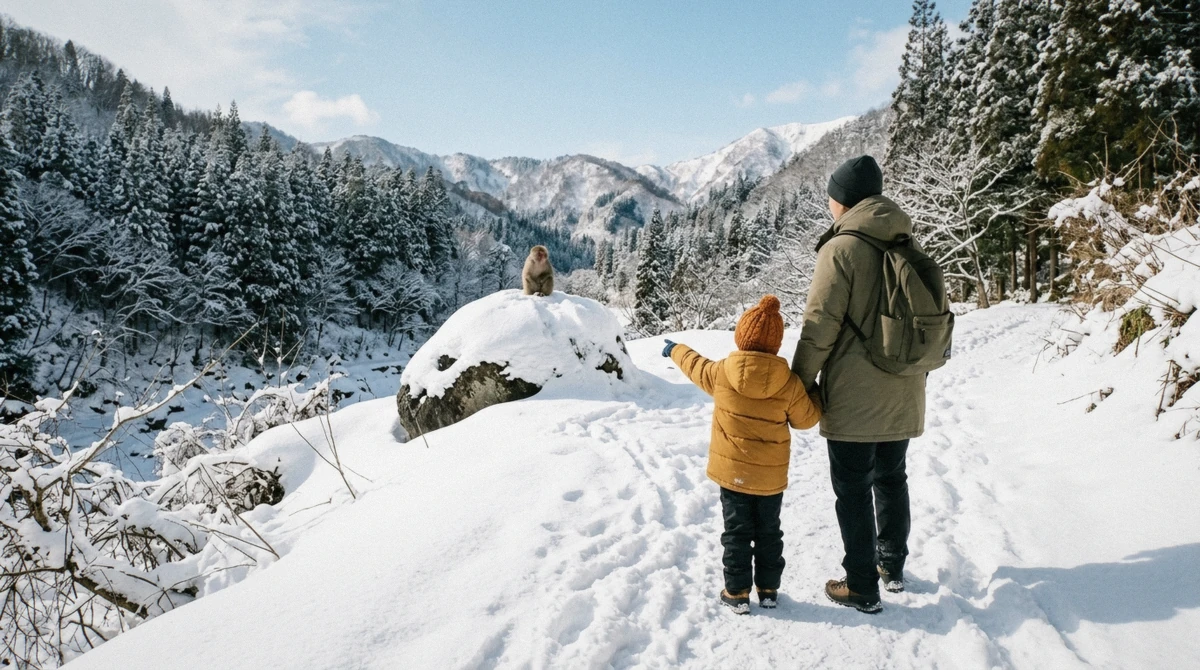
Quick answer The age rules, the trail reality, and which tour to book
Kids of any age can enter Jigokudani Monkey Park; admission is ¥400 (about $2.50) for ages 6 to 17 and free under 5. The real question is not age but the trail: 1.6 km of unpaved, often icy path with no stroller access, so a baby carrier replaces the stroller and a school-age child who can walk that distance comfortably is a better fit than a toddler who cannot.
Key takeaways
- Admission: free under 5, ¥400 (about $2.50) for ages 6 to 17, ¥800 (about $5.50) for adults
- The 1.6 km trail is not stroller-friendly; bring a baby carrier instead
- Coach tours accept all ages, including infants under 2 free without a seat, while the private car with child seats excludes under 2
- Families report about 3 hours door to door from the bus stop with small kids, and the trail is flat but can be slippery in winter
- Park rules for kids: no feeding, no touching, no staring the monkeys in the eye, and food stays out of sight in a closed bag
- For a calmer pace with a smaller group, the afternoon tour with a guide works well for ages 6 and up
Minimum Ages for Snow Monkey Park Tours
Age limits vary by tour, not by the park itself. The table below lists the actual minimum age per departure, drawn from each operator's own booking terms.
Age rules by tour
Every group coach tour on this site accepts children of any age, including infants; the two private-car options are the ones that draw an age line, and each does it for a different reason.
| Tour | Minimum age | Why the limit | Best for ages |
|---|---|---|---|
| Nagano day trip with Zenko-ji and sake | None, 0-2 free without a seat | Coach seating, no age restriction | 6-12, easy pace with lunch included |
| Afternoon tour with a guide | None | Small group, guided pace suits older kids best | 6+, families wanting a guide on the trail |
| Togakushi and Zenko-ji day tour | None | Long coach day, 8.5 hours total | 8+, kids who can handle a full day out |
| Tokyo coach with the snow-hut stop | None, 0-2 free without a seat | Coach seating, no age restriction | 6-12, sukiyaki lunch and admission included |
| Shiga Kogen buffet and museum tour | None, published child fare ages 3-11 | Coach seating with a set child fare | 3-11, one child fare per paying adult |
| Nagano winter private tour with a local guide | None, family pricing on request | Small private group, flexible pace | Any age, best for a toddler who needs a slower day |
| Private car with child seats from Tokyo | Under 2 excluded | Group cap of 5 with fitted child seats, not built for infants | 6-12, families wanting door-to-door pickup |
| Hakuba private tour | Ages 6 and up | Full-day pace and luggage-transfer logistics assume school-age kids | 6-12, families staying in Hakuba |
The pattern is clear: every coach tour draws no age line at all, and the two operators that do restrict age both cite the same underlying reason, a private vehicle set up around fitted seating and a pace built for older kids, not the trail itself. Age is enforced at booking, when the operator asks for each traveler's age, rather than checked by ID at the gate. To see every family-friendly tour side by side, the full lineup is easiest to scan on the homepage comparison table.
Which Tour Fits Which Age
If You have a toddler or infant under 2
book the Nagano winter private tour or a coach tour, since both take infants and let you set your own pace on the trail with a carrier
If Your child is 3 to 5
the Shiga Kogen buffet tour has a published child fare for this age band, and a coach seat means no trail pace pressure until you arrive
If Your kids are 6 to 12
the afternoon tour with a guide or the Tokyo coach with the snow-hut stop both fit this age well, with a guide on hand and enough novelty to hold interest
If You have teens who can handle a long day
any tour on the roster works, including the 8.5-hour Togakushi and Zenko-ji day tour
The Trail With Kids: Strollers, Carriers, and What It Feels Like
The trail itself, not the park's rules, is what actually shapes a visit with young children.
Strollers do not work here
The 1.6 km trail from the Kanbayashi trailhead runs over unpaved forest ground, packed snow, and ice through the winter months, and the park's own guidance is plain: it is not stroller or wheelchair accessible. A stroller left at the trailhead is the practical move for families who bring one; a baby carrier is what actually gets an infant or toddler down the path, since it leaves your hands free on icy ground.
What the walk feels like with small kids
Families report around 3 hours door to door from the bus stop with young children, once you count the walk in, time at the park, and the walk back at a child's pace rather than an adult's. The trail is flat with only gentle grade, which helps, but it can be genuinely slippery where snow has been compacted into ice, particularly from December through March. A school-age child who walks confidently on uneven ground handles the distance without much trouble; a child who tires easily on a 25 to 40 minute walk each way is the one to plan a slower schedule around.
Winter gear for kids
Adults typically rent crampons at the Gift and Info Shop near the trailhead for the icy stretches; a similar spike option sized for kids is not something every rental counter stocks, so check availability before you rely on it, and pack warm, waterproof boots as the fallback. On the Tokyo coach route, the tour adds a stop at the Kamakura no Sato snow-hut village from late January through late February, and its sledding slope is a genuine kid-friendly alternative if the trail walk itself feels like enough excitement for one day. Full boot and clothing rental details live on our what to wear guide.
Park Rules for Kids and What They Mean in Practice
No feeding, no touching, no staring
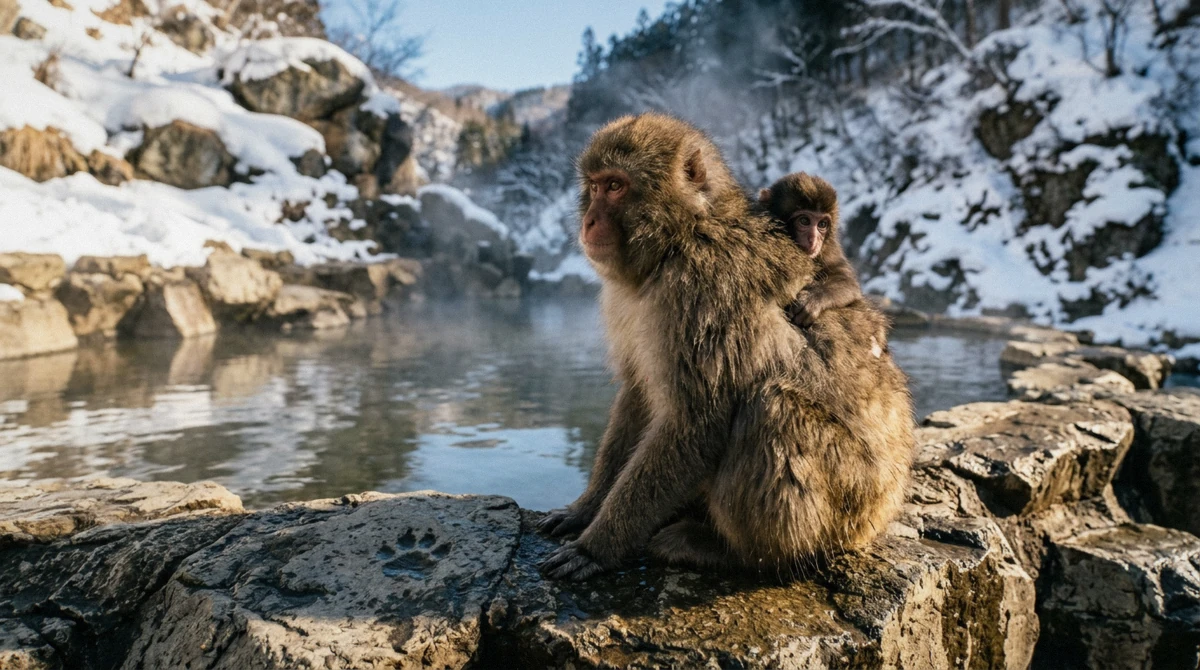
The park's rules apply to every visitor, and they matter most with kids who naturally want to reach out or make eye contact with an animal that close. No feeding, no touching, and no staring the monkeys in the eye, since direct eye contact reads as a challenge to a macaque. Food and anything that looks like a food bag stays zipped away and out of sight; a monkey that spots a snack in an open hand or a loose plastic bag will go for it.
Coaching a child before the trail
A short talk before you set out works better than a rule read off a sign at the gate: hands in pockets near the monkeys, no pointing fingers close to a face, and quiet observation rather than chasing a good photo. The troop generally ignores visitors who keep their distance and stay still, which is the easiest behavior to ask of a child who wants to watch rather than interact. If the trail itself feels like the bigger unknown, a guide on hand tends to settle nerves faster than any pep talk, which is the case for most of the family-friendly snow monkey tours on this site.
How Long Can Kids Actually Stay Engaged?
Attention span, not the clock, is what actually limits how a young child handles a day at the park. The table below matches the site's own age bands to what a realistic visit looks like for each.
Attention span by age
| Age band | Realistic focused-attention window | What that means for a day tour | Signs it's time for a break |
|---|---|---|---|
| Toddler (2-4) | 15-30 minutes of focused watching | The trail walk and wait for a good view can eat the whole window before the pool even comes into sight; keep the day short and build in a carrier nap | Fussing to be picked up, refusing to walk, staring blankly past the monkeys |
| Young child (5-7) | 30-60 minutes | Enough for the trail plus a solid stretch at the viewing deck, but a full 8.5-hour day tour is likely to run long by the afternoon | Asking repeatedly if it's time to go, fidgeting with gloves or a hood |
| Older child (8-11) | 1-2 hours | Comfortably covers the trail and a real look at the park; the coach tours' included stops (Zenko-ji, a sake brewery) can start to feel like downtime rather than adventure | Going quiet, wandering off from the group toward the railing |
| Tween/teen (12+) | 2+ hours | Handles any tour on the roster, including the longest 8.5-hour day; boredom here is more about phone signal than the monkeys | Checking the time, asking about the next stop rather than the current one |
None of this means a toddler will hate the trip; it means the plan should assume a shorter, slower visit rather than a full day, and that a private tour with a flexible pace, like the Nagano winter private tour, absorbs an early exit far better than a fixed-stop coach itinerary does.
Restrooms, Food, and What to Pack for the Day
The practical details parents actually search for, in one place.
Restrooms and a small shop sit at the Kanbayashi trailhead, near the parking area and bus stop, so the sensible plan is a bathroom stop before the walk in rather than counting on anything along the trail itself; there are no facilities partway. Snacks are worth carrying rather than buying on-site, since options near the trailhead are limited, and any food a child is holding should stay zipped in a bag once you're near the monkeys, both for the park's rules and because a visible snack draws attention fast.
What to pack
- Baby carrier instead of a stroller, for infants and toddlers
- Warm, waterproof boots for every child, plus a spare pair of socks
- Snacks and water carried in, not bought at the trailhead
- A closable bag for any food, kept out of sight near the viewing area
- Gloves and a hat for winter visits; the deck and pool area is exposed
- A change of layers if sledding at Kamakura no Sato is on the itinerary
Questions About Visiting With Kids
Is the snow monkey park stroller accessible?
No. The 1.6 km trail from the Kanbayashi trailhead is unpaved and often icy in winter, and the park states plainly that it is not stroller or wheelchair accessible. A baby carrier is the practical alternative for infants and toddlers.
How much does it cost for kids to enter?
Admission is ¥400 (about $2.50) for ages 6 to 17 and free for children under 5. Adult admission is ¥800 (about $5.50). Group tours generally include this fee in the price; the private car options leave it to be paid on-site.
What is the youngest age a child can visit?
There is no minimum age at the park itself, and most tours on this roster accept infants, some free under 2 without a seat. The two private-car tours are the exception: one excludes under 2, and the Hakuba private tour sets its minimum at 6, both for vehicle and pacing reasons rather than the park's own rules.
How long does a visit with kids actually take?
Families report about 3 hours door to door from the bus stop with young children, once the walk in, time at the park, and the walk back are counted at a child's pace. Add extra time for a first stop at the trailhead shop to sort out gear.
Are the monkeys safe to be around with children?
The troop is wild and generally ignores visitors who keep a respectful distance. Following the park's rules, no feeding, no touching, no staring, and keeping food out of sight, is what keeps interactions calm; there is no barrier between the trail and the monkeys, so supervision matters more than any physical safeguard.
Do kids get a discount on tours as well as park admission?
It depends on the tour. The Shiga Kogen buffet tour publishes a specific child fare for ages 3 to 11, one per paying adult, while most coach tours price children the same as adults but let infants under 2 ride free without a seat. Check each tour page for its exact terms.
Is there sledding or another activity for kids besides the monkeys?
Yes, on one route. The Tokyo coach tour adds a stop at the Kamakura no Sato snow-hut village from late January through late February, which includes a small sledding slope, a good option if you want more than the trail walk on the same day.